- Your cart is empty Browse Shop
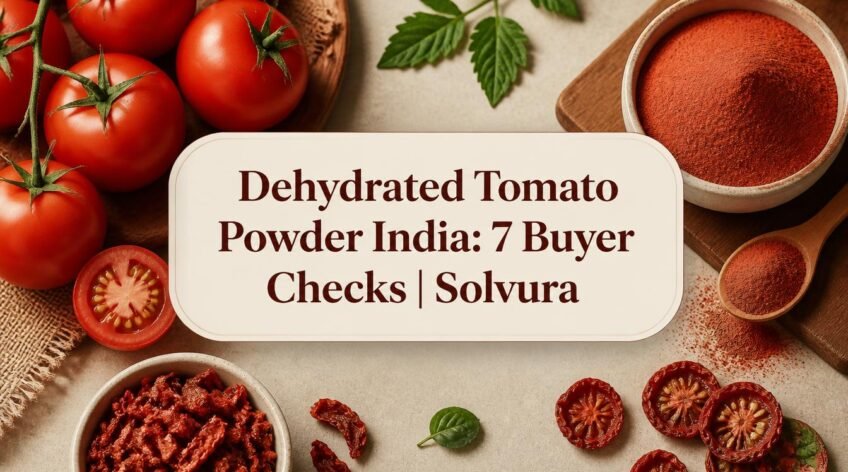
Dehydrated Tomato Powder India: 7 Essential Checks Before You Buy Bulk
Dehydrated tomato powder India is a genuine, budget-friendly way to get consistent tomato flavour and colour into soups, sauces, ketchup, seasoning blends and snack coatings, all year round. Fresh tomatoes are seasonal and heavy to ship. Powder is stable, light and easy to store.
But not all tomato powder is equal. This guide gives you seven practical checks to run before you place a bulk order, plus the documents and codes you will meet along the way.
What Is Dehydrated Tomato Powder?
Dehydrated tomato powder is made from ripe tomatoes (Solanum lycopersicum) that are washed, pulped or sliced, dried and finely milled. The result is a fine, free-flowing red powder that rehydrates easily and carries the tangy, natural flavour of fresh tomato.
Why Buyers Source Tomato Powder from India
India grows tomatoes across several states, and processors in Maharashtra and Gujarat, among other regions, dehydrate and mill them for the food industry. Buyers choose Indian tomato powder for its competitive pricing, year-round supply and the depth of processors able to handle both small trial orders and bulk containers.
7 Checks Before You Buy Dehydrated Tomato Powder in Bulk
1. Confirm the mesh size
Tomato powder is commonly milled to a fine mesh, and suppliers often quote ranges around 80 to 100 mesh for a smooth, free-flowing powder. Ask for the exact mesh and a tolerance, since a coarser or finer grind changes how the powder dissolves in your formulation.
2. Check the moisture content
Low moisture keeps the powder free-flowing and prevents caking. Suppliers commonly state limits under 5 to 8 per cent. Confirm the figure and ask how it is tested.
3. Ask about colour and lycopene
A rich, natural red colour signals good raw material and careful drying. Some suppliers quote a minimum lycopene content as a quality marker. Compare samples side by side under consistent lighting before you commit.
4. Review microbiological and pathogen results
Request a Certificate of Analysis covering total plate count, yeast and mould, and confirmation that pathogens such as E. coli and Salmonella are absent. This matters even more for a product used without further cooking.
5. Check for additives and purity
Ask for written confirmation that the powder contains no added colours, preservatives or anti-caking agents unless you have specifically asked for them.
6. Inspect the packaging
Tomato powder absorbs moisture readily. Ask about food-grade inner poly bags, sturdy outer packaging such as HDPE or kraft paper bags, and typical pack sizes. Confirm the stated shelf life, often around 18 to 24 months when stored correctly.
7. Verify supplier registrations
Ask for the exporter’s IEC and FSSAI licence, and check whether they hold ISO 22000 or HACCP certification for their processing facility. Verify copies with the issuing authority rather than trusting a website badge.
“I cannot believe in a God who wants to be praised all the time.”
Friedrick Nietzsche
Documents and HS Code for Tomato Powder Shipments
A typical export shipment includes a commercial invoice, packing list, bill of lading or airway bill, certificate of origin and Certificate of Analysis, plus any phytosanitary or health certificate your destination requires.
On the HS code: Indian exporters commonly classify dehydrated tomato powder under heading 0712 (dried vegetables), though listings vary between suppliers and platforms. Confirm the exact code with your customs broker before you file, since misclassification can delay clearance.
How to Choose a Tomato Powder Supplier
Request a sample from the actual production lot, not a display sample. Compare colour, aroma and mesh against your specification. Ask about capacity, seasonal raw-material changes and lead times. For the general process, see our step-by-step guide to importing from India and our supplier checklist.
Get Import-Export Guidance from Go 4 Export India
If dehydrated vegetable powders are new to your sourcing list, Go 4 Export India provides consultation on import and export from India, covering export services, global sourcing, documentation and logistics.

Source Dehydrated Tomato Powder with Solvura
Solvura works in international export and global B2B trade of Indian agricultural, food, natural and organic products, including dehydrated tomato powder and dehydrated onion powder. Share your mesh, moisture and volume requirements with the Solvura team to discuss your order. You may also want to read about dehydrated onion powder and moringa powder.
Frequently Asked Questions
What mesh size should dehydrated tomato powder be?
It depends on your application. Suppliers commonly quote 80 to 100 mesh for a fine, free-flowing powder. Confirm the exact mesh in your specification.
How long does tomato powder last?
Suppliers commonly state a shelf life of 18 to 24 months when stored in a cool, dry place in intact packaging.
Is dehydrated tomato powder the same as tomato flakes?
No. Powder is finely milled, while flakes are coarser dried pieces. Some suppliers offer both, and you should specify which form you need.
What tests should I ask for?
Moisture, microbiological results (total plate count, yeast and mould, pathogens) and, where relevant, lycopene content and pesticide residue results matched to your destination market.
Can I get organic dehydrated tomato powder from India?
Some suppliers offer certified organic options. Ask for the certification scheme and a valid organic transaction certificate for the specific shipment.